Design Your Own Native + Edible Garden: A Simple DIY Guide Using Free Tools
Beginner’s Guide to Regenerative Gardening in Los Angeles & Southern California
Written by Tate Tilles-Perrine
Edited by Sara Saxonberg
Starting a garden in Los Angeles can feel both exciting and overwhelming. From choosing the right plants to understanding sun exposure, soil, water needs, and local climate conditions, there are many factors that influence the success of a garden in Southern California. The good news is that gardening is a lifelong learning process, and every garden begins with curiosity, observation, and care.
At Pachamama Inspired, we believe gardens can nourish both people and the ecosystems around them. Based in San Pedro and serving clients throughout Los Angeles, the South Bay, Palos Verdes, and Orange County, we specialize in ecological landscape design rooted in biodiversity, water-wise gardening, California native plants, edible landscapes, and regenerative stewardship practices.
Southern California contains many unique microclimates, meaning the conditions in one neighborhood may differ dramatically from another just a few miles away. Learning to observe your environment (including sunlight, wind, soil conditions, drainage, and existing plant communities) is one of the most important first steps in creating a resilient and thriving garden.
Even if you do not live in Los Angeles or Southern California, many of the foundational principles shared here can help you begin developing a deeper relationship with your outdoor space wherever you are.
Why Garden Here?
To begin, before you decide what and where you want to plant, consider why you want to plant a garden. Could it be because you’re looking to source your own cooking herbs?
Or perhaps you want to witness the behavior of a local hummingbird species?
Maybe you love the way a plant smells or sprawls, and you just want it to grow closer to you?
There are so many valid reasons for starting a garden, and truly there’s no wrong choice as for why. But understanding your spark will help lay the foundation for where such a place could exist.
How to Choose the Right Plants and Garden Location in Southern California
Next, we encourage you to lean into the sensory experience of the space you have in mind.
What do you notice when you close your eyes? And when they are open, what is before you? If not directly in your vicinity, if you were to walk around your block, what would you experience?
While not every neighborhood has greenery that is equally distributed, what is noticeable in your area? This could simply be that you feel a breeze grazing your skin coming from a particular direction, or even the heat reflecting off of concrete as you circumvent the block.
This is all valuable information that will help you become more familiar with your space.
Whilst exploring, did you see any plant life growing in your surrounding area? Likely you witnessed a compilation of native, edible and ornamental plant species that all serve various functions relative to the users of those spaces.
For orienting purposes, what is considered a native plant?
A plant who has an ecological history of growing in a particular region for millennia may be referred to or understood as a "native plant". These plants have adapted to regional climate, soil and water resources, and they provide essential habitat for local species of wildlife. It’s important to remember that native plants of a particular region have evolved with people, and they surely reinforce our sense of place. It has been this co-evolution of land that has greatly shaped the landscapes we know so dearly today.
To qualify something as an edible plant, how would we know?
There are native plants that have edible qualities, and generally, we consider edible plants as ones whose fruits, leaves, shoots, and roots might be commonly eaten throughout various cultures in an area. It’s important to recognize that not every part of an edible plant is in fact edible. For instance, we eat the fruits of tomatoes, not their leaves- for good reason (their leaves would make us sick)!
Lastly, what’s considered ornamental?
Perhaps a plant that isn’t "native" to a region, an ornamental may have aesthetic, shade, cultural, emotional or sensory value. All are worthy reasons to consider the use of these plants. We advocate for climate-appropriate ornamentals, so that you can try to match the water needs of native plants and these additional species.
All that to say, a garden can include all of these types of plants, or some combination of them. Before you determine exactly where you want to place these plants, it’s important to remember that plants require care, presence, and willingness to be open to any outcome. Plants can be sensitive, although resilient, and they are very influenced by the conditions of a space.
So remember, while you can control many things in a garden, it’s ongoing success is still subject to environmental factors that can shift and change over time. It is through presence, observation, and developing an intimate relationship with your space that you begin to understand this ongoing dialogue with the natural world. Gardening is not about complete control, but about learning to participate in an evolving dance with the living systems around us.
Site Inventory and Analysis for a Los Angeles Garden
Exactly where you choose to plant a garden is going to be relative to the space you have available to do so. To help you decide, you’ll want to start by taking inventory of the site. Site inventory consists of looking at what’s likely to influence the growth of a garden space. Consider the following: sun exposure (throughout the year), wind exposure (prevailing/Santa Ana winds), annual rainfall in the area, climate, Sunset Climate Zone, and USDA Plant Hardiness Zone (if doing edibles).
Knowing these details will help you to then analyze your space and to determine how to pair your desires and needs with the reality of your space. Now, analyzing your site will help you to understand it more deeply. Consider: circulation- how will you arrive in space? Who is it for, for neighbors to walk or drive by to see? Noise- does this need to be mitigated? What’s its source? What are the main access points to the garden? Are there any views from which you’d like to see the space? Drainage, how will the water flow? Where is the water source?
Plant Communities of Los Angeles
Analyzing this information will help you to imagine how the garden can be experienced, by you, or whoever you imagine the users of the may be. Next, let’s think about how to choose plants that might fit within the conditions you’ve determined. When considering native plants, it’s important to understand the concept of plant communities.
Basically, there are plants that have evolved to live together as they have similar water, soil, or climactic needs. These plants can serve in union as valuable habitat (food, shelter, water sources) to various species of wildlife. Websites such as laspilitas.com (CA specific) can help you to determine the particular plant community in which your garden space exists. All you need to know is your zip code, and you can find out who has an ecological history in your area.
For edibles and ornamentals, it’s important to think about the Sunset Climate and the USDA Hardiness Zones to consider what might grow best in your region. These zones are relative to the conditions that will allow your plants to thrive. They specifically map the number of chill hours, or hours between 32 and 45 degrees fahrenheit, as some plant species require cooler temperatures to set fruit and to allow for dormancy. And for climate adapted ornamentals, it's important to know the climate in which you’re growing, as this will help inform plants’ water and soil needs.
In San Pedro, and the surrounding areas, we are in Sunset Climate Zone 24, and Hardiness Zone 10b. Both of these sets of data are useful in that they’ll help us determine what will grow best in the area. It’s best to consider plants with the lowest number of chill hours for the zones, as the low temperatures of the region don’t last for extended seasonal time.
Plant Communities of Los Angeles | Resources
Depending on what you choose to plant, there are various resources you can use to determine if the plant in fact could thrive at your site’s location. Calscape is a major tool to use when considering the types of native plants of CA you wish to grow. Similar to the Las Pilitas website, on Calscape you can type in your zip code, and it will put out a variety of plants that can be grown in your area. There are even maps per plant that, in yellow, show the areas that particular species grow throughout the state of CA. Also, you can select the plants you’re interested in and add them to a plant list that you can keep record of as you navigate the plant selection process.
While Calscape is very informative, we would suggest cross-checking chosen plants with the Tree of Life catalogue. This catalogue has more accurate mature plant sizing and can help you to better understand a plant’s growth habit and its water needs. Additionally, you could cross-check San Marcos Growers for more information about a plant’s behavior, as well as a bit about its ecological history in both the nursery trade and in nature.
When considering edible and climate-adapted ornamental plants you can consider growing in your area, visiting a local nursery is a good place to start. Nurseries should supply plants that can thrive in your general area. For instance, most Armstrong Nurseries in CA have plants that thrive in Mediterranean climates, as well as vegetables that tolerate cool wet winters and dry hot summers.
If you’re intending to plant seeds for your garden, there are some interesting websites that offer quality vegetable seeds that will keep you interested and curious about planting a variety of species over time. Johnny’s Selected Seeds and Baker Creek Seeds are two great seed sources to consider.
Simplifying the Plant Palette for your Los Angeles, Orange County or SoCal Garden
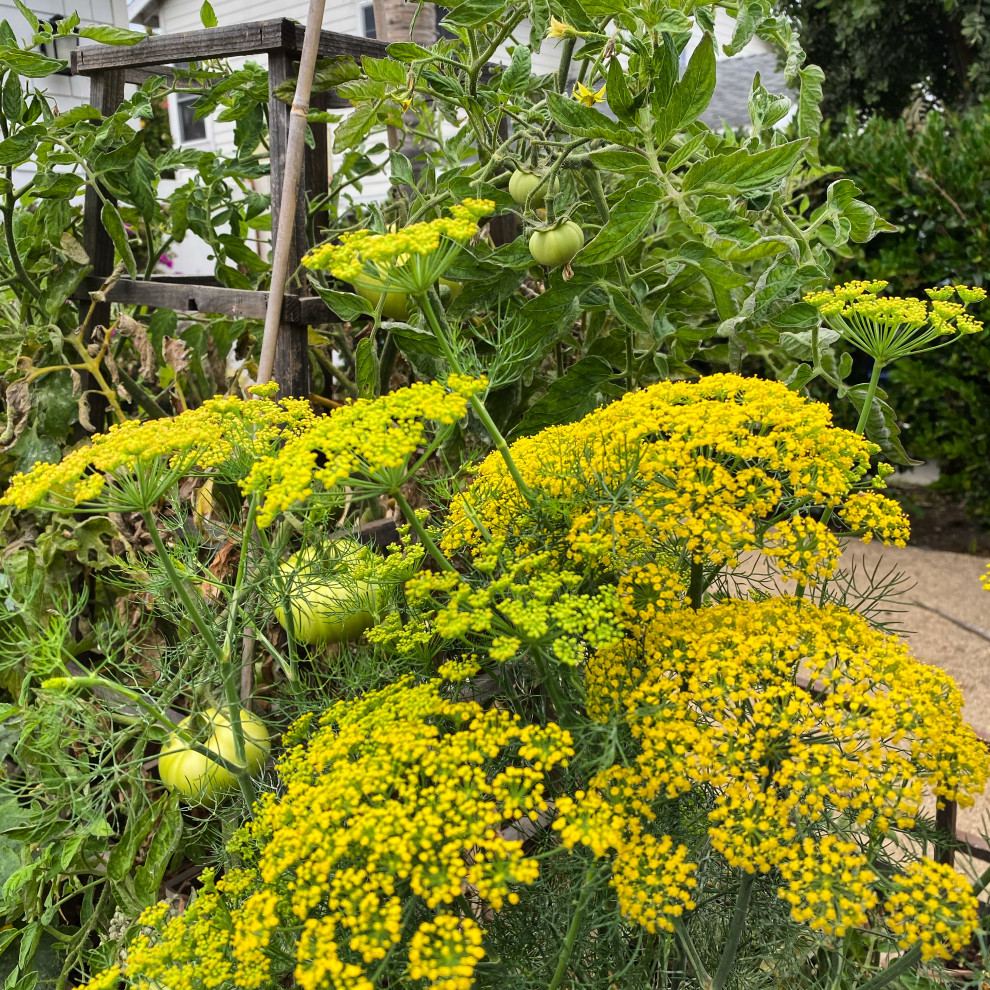
These tools will help you develop a simple palette. At first, it’s good to keep things simple and witness the complexities that exist within that structure. When deciding exactly where in your space to install plants, there are some additional things to consider.
Start by learning each plant’s individual water needs. Then you can group plants by “Hydrozone”, a fancy way of saying plants being planted relative to like-water needs. This will factor into the layout of an irrigation system, or even for the length of time you’d consider watering a selection of plants by hand. Pro Tip: websites like San Marcos Growers have great tools to reference this info.
Next, it’s important to know how large a plant will get in its mature stage of life. This will help you to understand where in your space there will be enough room for the plant to reach that size. Generally, we want to give plants space to be themselves! And yet, there are some plants who can be trained to fit into spaces they’d otherwise not naturally be. However, to keep things simple at first, let's think of a plant reaching its full size in the space.
Thereafter, what are the sun requirements of the plant? Does it thrive in shade, partial shade, or full sun? Knowing this will help us to determine where in the space a plant will get its sun needs met. It’s important to know that the growth habit of one plant can influence that of another. For instance, one plant could, over time, shade out a neighboring plant. This can be to the neighboring plant’s benefit or detriment, so it’s good to consider from the start- how large/tall/wide a plant intends to grow. Also, consider if a plant is deciduous or evergreen. Deciduous plants lose their leaves seasonally, often allowing more sunlight to reach nearby plants during parts of the year, while evergreen plants retain foliage year-round and provide more consistent shade. Understanding this difference can help you plan plant spacing and sunlight needs more successfully within your garden. This is one way to sidestep shade being a factor that inhibits growth of neighboring plants.
For edibles, some plants can actually support one another’s growth. For instance, the idea behind a Three Sisters Garden is that when planted together, corn, beans and squash can actually influence one another’s success. When beans are planted near corn, they can help fix nitrogen in the soil, which will help corn establish healthy leaves. Corn can be used like a structural trellis for pole beans to climb up and wiggle their way towards the sun. Squash has a sprawling growth habit, which when extended, can help cool the soil and keep it moist. They also have prickly hairs along their stems and leaves, which help manage pests that would otherwise try to sneak in the mix for tasty bites.
All that to say, thoughtfully considering how plants are placed within a garden is important. This practice is often referred to as companion planting — the idea that certain plants can support one another through shared shade, pollinator attraction, pest management, soil benefits, or compatible water needs. A simple online search can be a great starting point for learning about beneficial plant pairings, though there are also many books, guides, and garden planning tools available to explore the topic more deeply.
One thing to think about as well, is how large a plant are you planting at the start of the garden. When first planting a garden, it won’t look as it will look a decade later, but it’s important to consider the size of pot you’ll be planting.
Generally, most native groundcovers and shrubs are purchased from the nursery in a one gallon sized pot. There are some exceptions where you’ll find plants in 4” pots, but generally 1 gal is common. For larger shrubs and trees, 15+ gallon pots/boxes are to be considered, depending on the look of the garden you’re going for from the start. Obviously larger plants will make a garden look fuller, however, it will take them longer to establish themselves in the garden. They need more time to unwind their root ball that was established in the nursery. Transplant shock can also be harder on larger specimens, so this is something to consider.
Pro Tip: When installing larger container plants with an irrigation system, be sure to provide extra water directly to the nursery root ball during the establishment period. Newly planted root systems often need additional hand watering and deeper moisture while they adjust to surrounding soil conditions and begin extending roots into the native soil. Proper establishment watering can significantly improve long-term plant health and resilience.
Whenever possible, consider planting younger, smaller plants so they have the opportunity to establish strong root systems and adapt naturally to their new environment over time. While larger container plants may offer a more immediate visual impact, younger plants often establish more successfully and can develop greater long-term resilience within the landscape.
To create a fuller and more visually lush garden during the establishment phase, consider sowing seasonal wildflower seeds or interplanting with smaller, short-lived species that can thrive while slower-growing plants mature. Many layered and naturalistic gardens evolve over time, and thoughtful planting strategies can help a space feel vibrant and abundant from the very beginning while still allowing room for long-term growth and ecological balance.
Avoiding Common Mistakes in California Native Gardens
Additional things to mention: mistakes happen. Failing is an essential part of gardening. It’s the best way to learn about one’s space. Throughout the process of establishing a garden, plants will let you know when they are unhappy. They may droop, turn yellow, invite pathogens, or even all together lose limbs.
None of these symptoms need to reflect poorly on you, this is all important information to gather, to understand what may need to shift in order to better meet the needs of the plants. As mentioned previously, to garden is to know your garden. To be present in the space, and to understand its changing nature intimately.
It will take time for you to explore what this means to you, but as often as you can, observe your space. You don’t necessarily need to do anything each time you experience your garden, but just by being there, you can get a sense of what’s happening and if anything needs support. As your garden grows more resilient, so will you.
Pachamama Inspired Is Here to Support Your Southern California Garden Journey
Starting and tending a garden is a continual learning process, and you do not have to navigate it alone.
At Pachamama Inspired, we offer ecological landscape consultations, regenerative garden design services, educational workshops, and seasonal garden guidance throughout Los Angeles, the South Bay, Orange County, and Southern California.
Whether you are creating a California native garden, edible landscape, pollinator habitat, or water-wise outdoor space, our goal is to help you build a deeper relationship with both your garden and the living systems surrounding it.
We often remind ourselves that gardens do not grow in isolation. Healthy landscapes are shaped through interconnected relationships between plants, pollinators, soil biology, climate, wildlife, and people. In many ways, gardening is an act of participation within a much larger ecological community.
If you are looking for support as your garden evolves, we invite you to book a consultation, attend an upcoming workshop, or join our Regenerative Garden Circle community for ongoing education, inspiration, and stewardship support.
With patience, observation, and care, a garden can become far more than a landscape. It can become a place of nourishment, connection, resilience, and belonging.